The Cherokee Who Once Owned Eden Gardens
By Richard Moore, SBC&HS Historian Emeritus
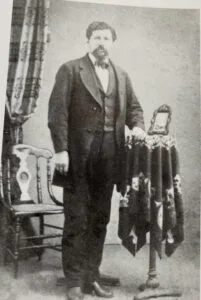 A fascinating thing about genealogical research is the amazing number of apparently unrelated events or places which turn out to be intimately connected through unexpected and often previously unknown relationships. Such an event is the early ownership of Eden Gardens by an energetic newspaperman named Edward Wilkerson (“Ned”) Bushyhead, a man with Cherokee Indian blood who survived the Trail of Tears as a child to later become the co-owner and first publisher of The San Diego Union, and owner of the area in Solana Beach which was developed as Eden Gardens.
Ned Bushyhead was six years old when his family was forced to relocate from their home in Tennessee to Indian Territory (now Oklahoma), where the Cherokee people were being resettled by the US government. His father Jesse, an ordained Baptist minister, set out in September 1838 with his pregnant wife and family, leading a contingent of 950 Cherokees to the new lands. After a delayed and particularly hazardous crossing of the icy Mississippi river in early January 1839, a baby sister to Edward was born. She was named Eliza Missouri, after her mother and the state they had then reached. Finally, the group, which now numbered 898, arrived in Oklahoma in February 1839, settling in an area near the Arkansas border which came to be called Breadtown (after its mission of providing food to subsequent Cherokee arrivals). Six births had been recorded on the journey, including little Eliza.
Breadtown, later known as Baptist Mission, soon had a newspaper, the Cherokee Messenger, started in August 1844. It was the first periodical to be published in the Indian Territory, and 12-year old Ned Bushyhead is believed to have learned the printing business there. The “History of San Diego County” recounts that Ned emigrated in 1850 to California, stopping first at Placerville. A year later he went to Tuolumne County, where he tried his hand at mining for two years. Printing was in his blood, however, and he moved to Calaveras County where he engaged his passion in newspaper publishing until 1868, when he was persuaded to move to San Diego by his then-employer, W. J. Gatewood. The Great Register of Voters shows he signed up to vote here on Sept. 3, 1868.
Ned Bushyhead had second thoughts about the San Diego move. He was skeptical that the newspaper that he and Gatewood started, The San Diego Union, would ever make a go of it. So unconvinced was he that he declined to list his name on the first editions as publisher, substituting instead the name of J. N. Briseno, the office boy. The first issue, published in Old Town, appeared on October 10, 1868. Despite Bushyhead’s initial concerns, the paper became an established newspaper, and adhered to an editorial policy of neutrality.
In June 1873, Bushyhead sold his interest in the paper for $5,000 to pursue other interests.Those other interests included matrimony, and in late 1876 Ned married the widow Helen Cory Nichols of New York. They adopted a daughter, who later died while still young. Helen was something of a mystic, and it is said that she set a place for dinner for her deceased daughter every evening.
Ned Bushyhead threw himself into his new avocations with the same passion and vigor he had as a publisher. From 1875 to 1882 he served as deputy sheriff of San Diego County, and then as sheriff from 1882 to 1886. Not neglecting his adopted city, he was the chief of police of the City of San Diego from 1899 to 1903, and was held in high esteem by the citizenry.
Real estate development in this burgeoning town of San Diego drew many entrepreneurs, Ned Bushyhead among them. One of his ventures was building an Italianate-style mansion as a rental. This house, moved from its original location, is still preserved in San Diego’s Heritage Park next to Old Town.
A look at the San Diego County Recorder’s archives hints at the extent of Bushyhead’s many real estate dealings. The transaction of most interest to us is his purchase of acreage in the square mile of Section 2, Township 14 South, Range 4 West, an area which encompasses most of southern Solana Beach. The original government patent for 160 acres of this land was issued to a Peter Trask from Maine in 1890. This 160 acres was later purchased by Ned Bushyhead, almost certainly as an investment. As was the custom at the time, wives were often recorded as the property owners, and an 1892 assessor’s map shows Mrs. H. C. Bushyhead as the taxable owner.
After Ned’s death in March 1907, his sister Eliza Missouri Alberty, now widowed by her second husband and living in the Cherokee Nation in Tahlequah, Oklahoma, had the responsibility for disposing of Ned’s land. In June 1909, she sold 130 acres of the land which abutted the Stevens’ Molly Glen Ranch for $3,000 to Jennie Cochran Stevens, wife of Edwin Stevens. This 130 acres included all of present-day Eden Gardens. Edwin’s nephew Mark Stevens, active in real estate, had urged Jennie and Edwin to purchase the property. They scraped the money together and did so. Later, Jennie subdivided the land and sold it for a 10-fold profit with the help of Col. Ed Fletcher’s brother-in-law – – but that’s another story.
And the unusual name?? Indian customs led to names based on physical attributes. Ned’s great grandfather, a young Scottish officer with the British army, had come to the Colonies as an Indian agent. He married a Cherokee woman, living the rest of his life among the Cherokees. The young officer was called “Bushyhead” because of his luxuriant curly red hair.
Resources for this article included publications of the San Diego Historical Society and the Oklahoma State Library, and the research of Richard Moore and Richard Schwartzlose of the Solana Beach Civic & Historical Society.
Col. Ed Fletcher and His Namesake Cove
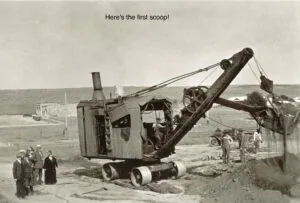
Many visitors to Solana Beach may not know that Fletcher Cove was man-made. In 1924, Colonel Ed Fletcher and his wife Mary watched as a steam shovel took the first scoop to open the bluffs and create easier access to the beach below.
 Two years prior, in 1922, Col. Fletcher — he liked to use the title he earned in the military reserves — purchased 140 acres of undeveloped land from George Jones. Jones had farmed in this area starting in about 1913 and, at the time, lived in one of just two houses in Solana Beach. His was on Barbara Street; his sister, Lucy Estes, lived in the first home to be built here, on Highway 101.
Born in Massachusetts, Fletcher came to California at age 15 in 1888 to join his sister Bessie, one of five siblings who had been raised largely in foster homes after his mother’s death (when Ed was just four years old) and his father lost his business and abandoned the children.
In San Diego county, Fletcher took a job moving produce and got to know the rural farming and undeveloped back country. He became fascinated with the idea of building dams and putting water to use in our arid region.
At 23, Fletcher traveled back to the Boston area to marry his childhood sweetheart, Mary Batchelder. After returning to San Diego, he opened his own wholesale grocery business, which thrived. But Fletcher remained fixated on land and water development. He found work with the South Coast Land Company, which was heavily involved in the development of Del Mar. The company sold more than $500,000 of real estate in the area and operated a grocery store. Fletcher recruited his brother-in-law, Eugene Batchelder, to run that grocery business.
The pair would eventually become known as the founders of Solana Beach. But it all depended on finding fresh water that could support development.
Before buying land here, Fletcher had sold his grocery businesses and developed a successful career in dam and land development. He started as a manager of the Warner Ranch hotel and hot springs; he built a country home there, which his descendants still enjoy today. Next, he got a job as manager of the Volcan Land and Water Company, which was formed to build the dam for Lake Henshaw. He went on to recruit investors for and manage construction of the Grossmont, Murray, Sutherland, Pamo, San Clemente and El Capitan dams — and their neighboring communities — as well as the dam called Hodges.
That project came about because the Santa Fe Railroad needed to turn around its money-losing eucalyptus farming project in what is now Rancho Santa Fe. The trees had proven useless as railroad ties. By 1911, Col. Ed Fletcher had developed a reputation as a visionary with deep knowledge of the area and the techniques and deal-making required to develop its water resources. W.E. Hodges, then-president of the railroad’s subsidiary, the Santa Fe Land Improvement Co., turned to Fletcher for help in actually improving the Santa Fe land.
Fletcher and his longtime partner, Batchelder, abandoned the tree farm to raise profitable cattle and grain instead. They added beets and envisioned citrus crops, but water was again key. Fletcher scouted potential dam sites, charmed railroad executives, and brokered a deal for W.G. Henshaw to sell all of his land that would become the dam and Lake Hodges to the Land Improvement subsidiary. Development by the subsidiary circumvented Clayton Act restrictions against having a railroad construct dams and water distribution systems.
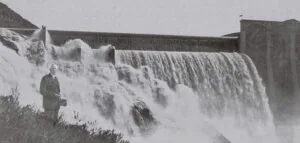 The 146-foot high, 750-foot wide Lake Hodges Dam opened in 1918, creating an eight and a half mile long lake. Initially, 2.5 billion gallons a day flowed over its spillway. Fletcher was named President of the new San Dieguito Mutual Water Company and began developing the distribution lines that would irrigate Rancho Santa Fe and service Del Mar, La Jolla, Cardiff, Encinitas, Leucadia and Lockwood Mesa — the farming mesa above San Dieguito lagoon. In 1919-20, water company Operations Manager Eugene Batchelder bought 10 acres in Lockwood Mesa from Ed and Jennie Stevens, some of the earliest settlers here. The reason?
Large numbers of Mexican laborers were brought in to lay the main water distribution lines from Lake Hodges and install irrigation for citrus groves, as well as to grade roads for the planned residential community. They initially lived in a tent city located just about where the Santa Fe Irrigation District offices in Rancho Santa Fe are today. But from the outset, Rancho Santa Fe was envisioned as a “highly restricted, exclusive community of country estates for gentlemen farmers.” White gentlemen. The migrant worker camp in the middle of town was a public relations and sales problem. Batchelder was tasked to fix it.
He built rustic cabins on the land he had purchased along Ida Avenue to relocate the workers into their own colonia. There were three types — one 12-by-12-foot “single man’s cabin,” four 14-by-24-foot cabins divided into four rooms, and seven 20-by-30-foot “family cabins.” The residents not only worked in Rancho Santa Fe, but also labored to extend water distribution lines to Ida Avenue to service a communal shower and laundry facility. That’s how our first neighborhood — La Colonia — was founded.
Batchelder also is credited for coming up with the name for his and Fletcher’s new town — Solana (sunny) Beach. With fresh water becoming available, the area was now poised for rapid development. One hitch — “There’s no beach here,” early resident H.G. Larrick Sr. griped to Fletcher. “Why of course there is,” he replied, according to recounts in old editions of the San Dieguito Citizen. “You just take that trail. . . climb that small hill and on the other side you’ll find a beautiful cove!”
But how much better if the beach could be seen from the main road, Highway 101? After his 140 acre purchase, Fletcher laid out plans for the Plaza and got permission to use water from the Lake Hodges spillway to run a high pressure hose through the sandstone bank, 100 feet high and 400 feet wide. After the first steammshovel scoop, he wrote in his 1952 memoir, “it was a most interesting sight to see one man for three months, using hydraulic pressure, melt away the soil.” Fletcher called the process “hydraulicking.”
The newly carved out cove’s grand opening was on July 4, 1924 with a celebration that famously included horse races on the beach. Residents flocked to the bluff top and new stairway; hundreds of visitors came from as far as Escondido. Ever the developer, Fletcher took advantage of the event to advertise lots for sale. In the 1930s, he donated the bluff-top land — now Fletcher Cove Park — and mile of ocean frontage to the County. He later told the Citizen that he had envisioned building a “splendid concrete pier” for commercial fishing.
That plan was not realized, but stones moved from the Hodges worksite were used to create a walled entry to the beach, part of which remains today. They were also used to build a bathhouse/latrine. In front of that, County lifeguards erected a watch tower that was rumored among area surfers to be the remains of a World War II pillbox. It wasn’t, but the idea become a nickname for the beach. Or maybe the nickname arose in the 1970s when the cove became, according to some reports, “a haven for drugged-out beach bums.” Either way, among long-time locals, “Pillbox” still is the cove’s “proper” name.
It wasn’t until 1987, a year after Solana Beach’s incorporation, that City Council voted to officially name “Fletcher Cove.” The decision was not without controversy — reports of the developer’s segregationist “whites only” home sales policies naturally surfaced. But Council members pointed out that such clauses were common in the county in the 1920s and had been outlawed in the late 1940s.
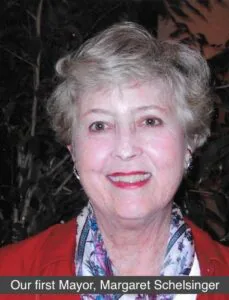
Margaret M. Schlesinger 1935 – 2016
Margaret M. Schlesinger was the first mayor of Solana Beach and a long-time community and environmental activist in San Diego County. She served as mayor from July 1986 until December 1988, following a vote by the newly formed City Council to appoint the mayor on an annual rotating basis. She remained on City Council and took the Mayor’s gavel again in 1993.
Margaret was born on May 18, 1935 in Tampa, Florida, the daughter of a Baptist minister and the granddaughter of Christian missionaries in China. Her family and upbringing instilled in her a strong sense of the importance of helping others and social justice that manifested in a long career in public service. She also served as a Deacon at the Solana Beach Presbyterian Church.
Margaret attended high school in St. Joseph, Missouri and went to the George Washington University in Washington, D.C. where she received a B.A. in political science.
Her involvement in politics began in Washington, D.C. in the late 1950s where she served as an intern at the Pentagon and worked on Capitol Hill for a Congressman from Indiana.
Margaret married Patrick J. Schlesinger in 1959 and moved with him to California in 1963. In 1978, the couple and their two children moved to Solana Beach. “We were attracted to the coast and to Solana Beach’s lack of pretension,” she said of the move.
Active throughout her life in the League of Women Voters, she worked on political campaigns in Oakland and eastern San Diego County before moving to Solana Beach in 1978. She also served as a county planning commissioner and served on advisory boards for County parks and for planning and land use.
In June 1986, Margaret was one of the leaders of Citizens Intending to Incorporate, a group of residents who successfully incorporated Solana Beach to give the new City greater control over its local affairs. She immediately set to work with other civic leaders to provide tangible benefits, including construction of a new train station, the lowering of tracks under Lomas Santa Fe Drive and the establishment of a new City Hall.
After leaving city government in 1994, Ms. Schlesinger continued to work on issues related to her city work including the San Dieguito River Valley Regional Open Space Park Joint Powers Authority and the San Elijo Lagoon Conservancy. She also remained active with a number of nonprofit organizations such as the League of Women Voters, and the Coastal Community Foundation. She was a long-time member and served as president of the Solana Beach Civic & Historical Society in 2007-2008.
Celine Olson, 1925 – 2021
 Celine Olson became a member of the first City Council of Solana Beach and the City’s fifth Mayor, after leading a years-long campaign for incorporation.
Celine was born on September 26, 1925 in Philadelphia, Pennsylvania to Edward F. Sweeney and Angele (Sauret) Sweeney. She graduated from John W. Hallahan Catholic Girls High School in 1943 and volunteered with the Navy League and sold war bonds in addition to working for AT&T as a draftsman. While doing her volunteer work in 1945 she met a dashing naval officer, Joseph C. Olson. They continued their relationship by exchanging numerous letters while he was at sea during the war and in May of 1946, they were married in the chapel at Naval Air Station North Island in San Diego.
Celine was a Navy wife for the next 17 years and raised five children while moving around to Philadelphia, Boston, Michigan, Washington, Japan and San Diego. While living in San Diego she became active in local civic affairs and was instrumental in saving the quiet neighborhood of Mission Hills from over development. After a total of about 25 years in San Diego and the kids mostly moved out, Celine and Joe decided to make Solana Beach their home in 1975.
Celine soon became active in the community and helped to save the canyon side overlooking San Elijo Lagoon near her home from development. Her participation and activities included four years with the San Dieguito Citizens Planning Group; eight years with the Solana Beach Town Council, two as President; the Solana Beach Women’s Civic Club, where she championed the effort to create the Solana Beach Friends of the Library, serving as President in 1984, and helping make the new library a reality; a North County Transit Board District Director working on establishment of the new train station and the Coaster service; the Shoreline Erosion Committee; and past President (1994-96) and member of the Solana Beach Civic and Historical Society for many years. She was a staunch life-long Republican and proud member of the Republican Women’s Association.
Her proudest achievement aside from her family was as a leader in the effort to incorporate Solana Beach starting in 1979 which became a reality on July 1, 1986, serving as Council Member for four years and Mayor in 1992. She truly loved Solana Beach, her home of 45 years.
She loved to travel with Joe, whether by train, ship or automobile taking several cruises and visiting places like China, Scandinavia, Europe, Mexico, Hawaii, Alaska and the Great Northwest. She also loved to dine out including at Fidel’s and Tony’s in Eden Garden.
Celine was preceded in death by her husband of 63 years Joe in 2009, son Richard Olson (wife Raquel) of San Diego in 2017, and daughter Dianne Ray (husband Randy) of Hauula, Hawaii in 2018.
She is survived by daughters Sue Wilson (husband Gordon) of Chatsworth, Georgia and Patti Olson of San Diego, and son Eric Olson (wife Jo) of Warrenton Oregon, seven grandchildren and eight great grandchildren.
Celine Olson died of natural causes at her new home near Warrenton, Oregon on July 19, 2021 at the age of 95. She rests at Fort Rosecrans National Cemetery with her loving husband.
Richard Moore, 1930 to 2025
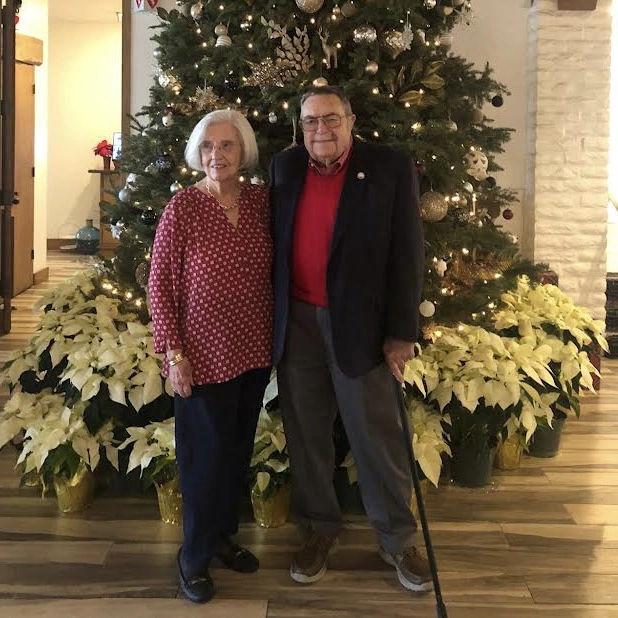
The Society lost a dear friend on September 1, 2025 when Richard Moore passed away at his historic home on South Nardo Avenue. He was 95.
Frances and Richard moved to Solana Beach in 1964 from Kansas for a nuclear engineering position at General Atomics. They settled into their 1928 Spanish Colonial home when the neighborhood still featured avocado groves, flower farms and an orchid nursery. Their two children, Beth Ann and Richard, raised lambs and chickens.
After several apartment complexes went up on the bluffs above Via de la Valle Avenue, the Moores were instrumental in convincing the County Board of Supervisors to block further development of multi-family housing on then-rural Nardo Avenue by circulating a petition with neighbors. They later helped to promote the campaign for Solana Beach Citihood, which was successful in 1986.
Richard was born in 1930 on his family’s wheat farm in Pratt, Kansas. He and Fran met in the 1950s at the University of Kansas, where he studied nuclear physics and she earned a BA in American History. After completing his Masters, Richard earned a Diploma in Nuclear Engineering from the Oak Ridge School of Reactor Technology in 1952. During the Korean War, Richard served in the Army, based with Fran at the large Utah weapons testing facility, Dugway Proving Ground.
He and Fran later returned to the University of Kansas, where Richard earned his Ph.D. in Nuclear Physics in 1963. Richard specialized in fast-spectrum nuclear reactions for space power; he later turned his attention to nuclear power reactor safety programs. After completing his Ph.D., Richard was recruited to San Diego by General Atomics. In the early 1970s, he accepted a two-year fellowship at Argonne National Laboratories near Chicago. He returned to Solana Beach to complete 20 years with General Atomics, retiring in 1986. The couple rented out their home for a move to Atlanta, where Richard partnered with a fellow nuclear physicist to start a medical device company now known as Theragenics. There, Richard helped develop an isotope treatment for liver, prostate and brain cancer.
From there, the couple moved in 1990 to Washington, D. C., where Richard took a seven-year position with the Office of Nuclear Energy in the Department of Energy, lending his expertise in nuclear physics to advancements for the military and other industries.
Retiring home to Solana Beach, the Moores became very active with the SBC&HS. Richard served for many years as our Research Historian, ferreting out the true story of the “pillbox” — a World War II fire control structure — as well as writing a regular newsletter feature called “The Way it Was — I Think.” He helped organize and transcribe many “older timers” interviews with long-time residents of Solana Beach — a tradition Richard and Fran helped us continue in 2021 when they sat down with then-president Michele Stribling for a video interview. He also took a part in our Living History Program skit for third graders. He enjoyed dressing
the part and demonstrating basic farm tools at the Stevens House.
Richard delved into the ancient history of the area to develop a limited-edition book and slide show on “The 11,000 Year History of the Western San Dieguito River Valley.” Richard also was a key contributor of research for former SBC&HS President Jim Nelson’s two books about Solana Beach history. He wrote the story of Ed Fletcher’s sugar beet farm near what is now the Del Mar Fairgrounds. He also compiled “The Service Eternal,” a Remembrance of local servicemen killed in World War II, the Korean War and the Vietnam War, which was presented to the City
during dedication of the War Memorial in our Town Plaza.
Richard’s intellect was matched by his insatiable curiosity and his quick wit. He left a considerable “to do” list of historical research topics for our continued pursuit!